DU 101: What is Raw Denim?
Summary
Raw denim is denim that has not been pre-washed or artificially distressed — it's a living fabric that begins as a sheet of deep blue and fades into something personal through wear. It comes in two forms: unsanforized (straight from the loom, shrinks 7–10% on first soak) and sanforized (mechanically pre-shrunk, minimal shrinkage) — both qualify as raw. The fades you develop are yours alone, written into the fabric by the specific contours of your body and your life.
Q&A
What is raw denim?
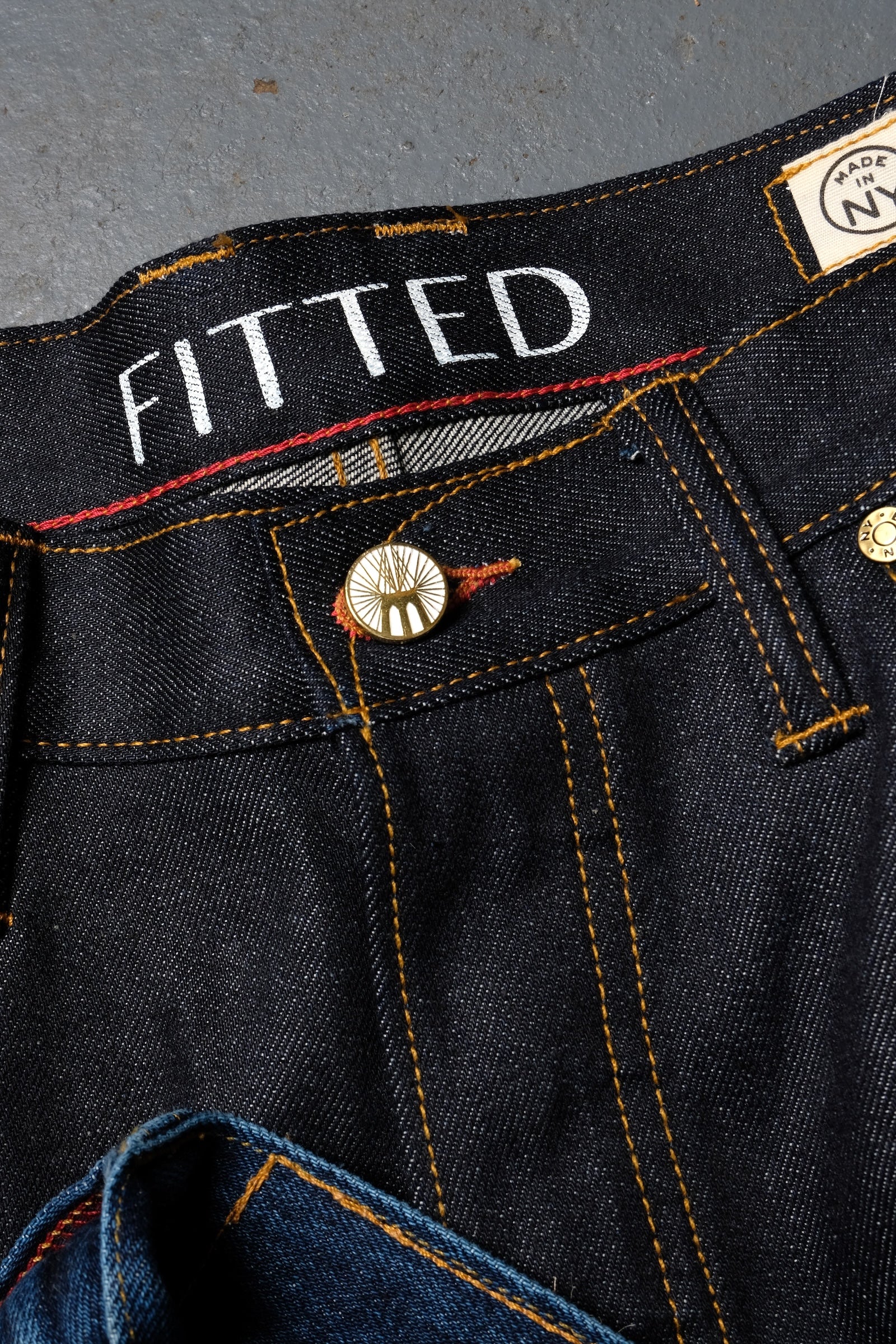
Raw denim is denim that has not been pre-washed, stonewashed, enzyme washed, or artificially distressed. It leaves the mill as a stiff, dark fabric and fades naturally through wear — developing patterns unique to the person wearing it. It comes in two forms: sanforized (pre-shrunk, minimal shrinkage) and unsanforized (loom state, shrinks 7–10% on first soak). Both are considered raw denim.
What is the difference between raw denim and regular denim?
Regular mass-market denim is put through industrial finishing processes — washing, stonewashing, acid washing, laser distressing, chemical softening — before it reaches the store. The fades are manufactured and applied uniformly to every pair. Raw denim skips all of that. The fabric is sold in its natural state, and the fades develop through wear, shaped entirely by the individual wearer's body and habits.
Is sanforized denim still raw denim?
Yes. Sanforization is a mechanical pre-shrinking process — the fabric is moistened, stretched, and heated to stabilize it before cutting. It is not a distressing treatment and does not alter the indigo or the character of the cloth. Sanforized denim is still unwashed and unfaded; it qualifies as raw denim. The distinction between sanforized and unsanforized is about shrinkage management, not rawness.
Why does raw denim fade the way it does?
Indigo is insoluble in water, so it bonds only to the surface of the yarn rather than penetrating to the core — leaving the center of each thread white. As the fabric is worn, the surface indigo gradually abrades away at points of friction and flexion, revealing the white core beneath. Because this happens at different rates depending on how your body moves, the resulting fade patterns — whiskers, honeycombs, wallet fades — are specific to you and no one else.
How long does raw denim last?
A well-made pair of raw denim jeans can last a decade or more with proper care. Unlike pre-washed denim, which begins degrading from its first wear, raw denim breaks in gradually — becoming softer, more supple, and more personal over time. The cost-per-wear math consistently favors raw denim over cheaper jeans that need to be replaced every year or two.
Test Your Knowledge
Click each answer to reveal whether it's correct.
1. What does "raw" mean when applied to denim?
A. Woven on a shuttle loom
❌ Incorrect. Shuttle loom construction describes selvedge denim, not raw denim. Raw and selvedge are related but distinct — you can have one without the other.
B. Made from unprocessed cotton
❌ Incorrect. Raw denim refers to the finishing of the fabric — or the absence of it — not the state of the cotton fiber before weaving.
C. Not pre-washed or artificially distressed
✓ Correct. Raw denim is defined by what it isn't — not pre-washed, not stonewashed, not artificially distressed. Both sanforized and unsanforized denim qualify as raw as long as the fabric has not been artificially aged or distressed.
D. Unsanforized only
❌ Incorrect. Both sanforized and unsanforized denim are raw denim. The distinction between them is about shrinkage management, not whether the denim is raw.
2. Why does indigo bond only to the surface of yarn rather than penetrating to the core?
A. It is applied at too low a temperature
❌ Incorrect. Temperature is not the reason. Indigo's surface-only bonding is a function of its chemistry — it is insoluble in water and bonds through oxidation on contact with air.
B. Indigo is insoluble in water and bonds through oxidation on contact with air
✓ Correct. Indigo is insoluble in water, so it can't soak into the fiber. It undergoes a chemical reduction to become temporarily soluble, then bonds to the surface of the yarn when it re-oxidizes on contact with air. The core of the cotton yarn stays white — which is what makes raw denim fading possible.
C. Cotton fibers repel indigo molecules chemically
❌ Incorrect. Cotton doesn't repel indigo — indigo bonds to its surface readily. The surface-only bonding is a result of indigo's own chemistry, not a property of cotton.
D. The yarn is coated in sizing before dyeing
❌ Incorrect. Sizing is a starch treatment applied during weaving, not before dyeing, and it doesn't prevent indigo penetration. The surface bonding is inherent to indigo's chemistry.
3. Which of the following is true about sanforized denim?
A. It is not considered raw denim
❌ Incorrect. Sanforized denim is still raw denim. Sanforization is a mechanical pre-shrinking treatment — it is not a distressing process and does not alter the indigo or the character of the cloth.
B. It has been pre-distressed at the mill
❌ Incorrect. Sanforization is a pre-shrinking process, not a distressing process. The fabric is moistened, stretched, and heated — but it remains unwashed and unfaded.
C. It shrinks 7–10% on first wash
❌ Incorrect. That's unsanforized denim. Sanforized denim shrinks only 1–3% after purchase, because the mill has already removed most of the shrinkage under controlled conditions.
D. It is mechanically pre-shrunk but still qualifies as raw denim
✓ Correct. Sanforization is a mechanical pre-shrinking process — steam, stretch, heat — that stabilizes the fabric. It is not distressing. Sanforized denim is still unwashed and unfaded, and fully qualifies as raw denim. The distinction from unsanforized is about shrinkage, not rawness.
4. What makes raw denim fades unique to each wearer?
A. The indigo wears away faster at points of friction specific to that person's body and movement
✓ Correct. Because indigo bonds only to the yarn's surface, it wears away gradually at points of friction — the creases, the bends, the pockets. Those points are determined by your body's specific shape and movements, which is why no two people's fades are ever exactly alike.
B. Each person's skin chemistry reacts differently with indigo
❌ Incorrect. Skin chemistry plays no meaningful role in how raw denim fades. The patterns develop through mechanical abrasion — friction at points specific to your body's shape and movement.
C. The denim is dyed in different concentrations for each batch
❌ Incorrect. Dye concentration varies between fabric runs but is consistent within a batch. The uniqueness of fades comes from how each individual wears the jeans, not from variation in the dyeing.
D. Unsanforized denim shrinks differently for each person
❌ Incorrect. Shrinkage affects fit, not fades. The uniqueness of raw denim fades comes from the specific patterns of friction and wear that develop according to each person's body and habits.
← Previous: DU 005 | ↑ Denim University | Next: DU 102 →
By Eric Steffen
Founder / Maker
FITTED Underground
Let's start with an admission: "raw denim" is a slightly confusing term. Most denim vocabulary tells you what something is. Raw denim, at its core, tells you what something isn't. It's a negative definition — and understanding that distinction is an important first step towards unlocking this curriculum.
Walk into any mass-market clothing store and the jeans on the rack have been through an industrial obstacle course before they got there. Washed. Stonewashed. Acid washed. Enzyme washed. Sandblasted. Laser distressed. Bleached. Artificially faded. Chemically softened. The manufacturers have done everything possible to make those jeans look and feel like they've already been worn for years, before they've been worn for a single day. Let's be honest here — they're comfortable, but disposable. For denimheads, those fades are manufactured, not earned, and lack the depth and history of a well loved pair.
Raw denim is the opposite of all of that. It is denim that has not been pre-distressed. It's a beautiful sheet of dark blue that's ready to age with you for years to come.
What Raw Denim Is — and Isn't
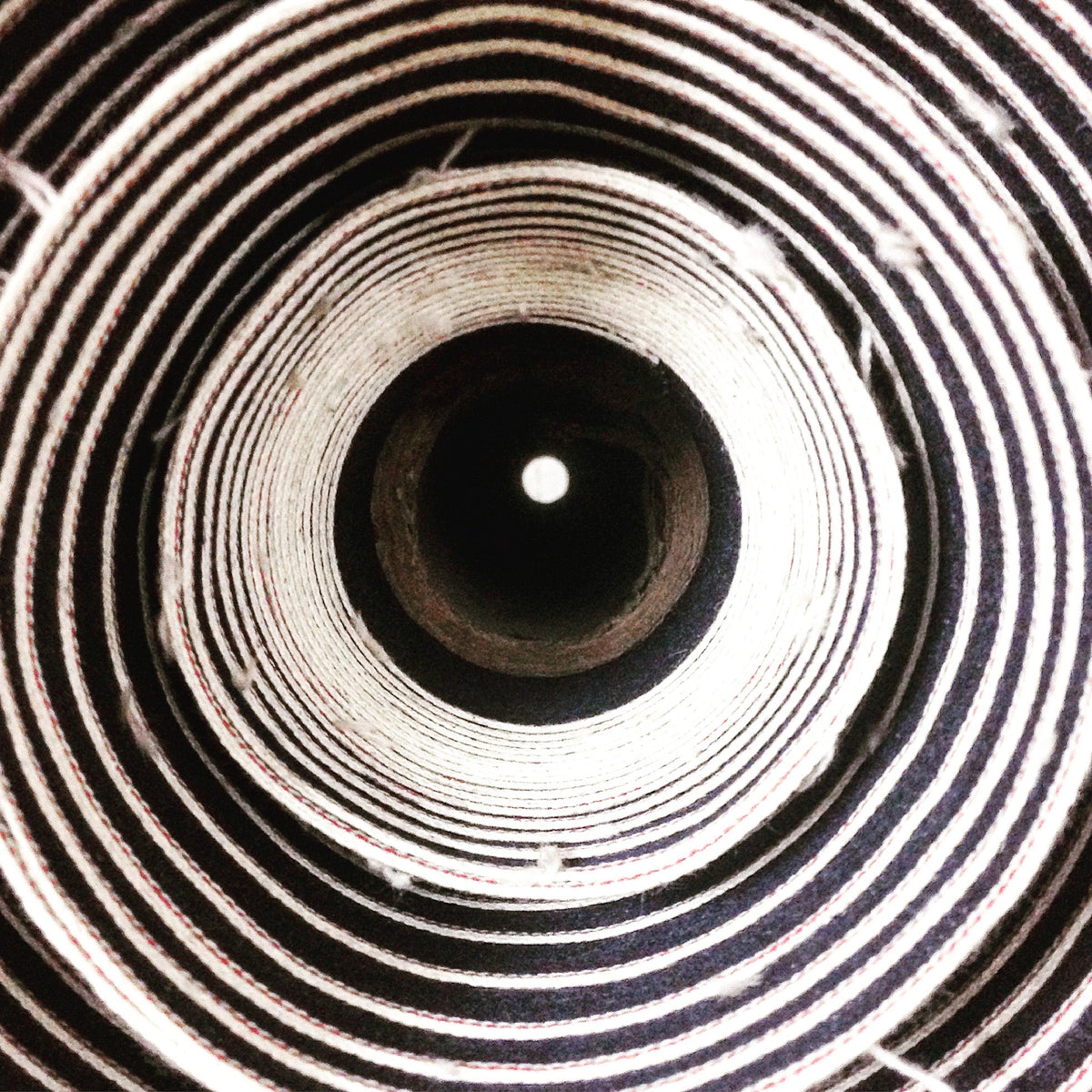
Denim is a 3x1 weave. What that means is that each horizontal (weft) thread passes under three vertical (warp) threads before it passes over a vertical thread, and then repeats that process all the way across the face of the loom. With classic indigo denim, the vertical / warp threads are indigo and the horizontal / weft threads are white. That results in the fabric having a dark indigo exterior and light white interior. And the 3x1 weave, we should note, results in a diagonal rib, also known as a twill. That's denim.
Raw denim just means nothing else has happened to the fabric. Or almost nothing else has happened to it. Let me explain.
There are two forms of raw denim. The first is unsanforized denim, also called loom state, shrink-to-fit or, in Japanese, kibata. This fabric goes straight from the loom to the cutting table with nothing done to it whatsoever. No washing, no pre-shrinking, no treatment of any kind. It is as close to the loom as a finished garment can be. The trade-off is significant shrinkage — typically 7 to 10 percent on first soak, which means you need to buy a size or typically two larger to account for what happens when the fabric first meets water. The benefit is that unsanforized denim retains every characteristic from the loom in its most uncompromised form: the texture, the hairiness, the irregularities in the weave. For the devoted raw denim enthusiast, this is often the most prized expression of the fabric.
The second is sanforized raw denim, which is what most raw denim on the market actually is. This is also known as pre-shrunk. After coming off the loom, the fabric goes through a process called sanforization — a mechanical pre-shrinking treatment invented by, and named after, Sanford Lockwood Cluett in 1930. The fabric is moistened with steam, stretched, and heated to stabilize it. The result is that most of the shrinkage happens at the mill before you ever touch the garment, leaving only about 1 to 3 percent to occur after purchase. To be clear, sanforization is a treatment, but it is not pre-distressing. The fabric remains unwashed, unfaded, and untouched in the ways that matter. It is still considered raw denim.
Many people assume raw means completely untreated — that any process applied to the fabric disqualifies it. That's not quite right. The defining characteristic of raw denim is not the absence of every treatment. It is the absence of pre-distressing treatments. Both sanforized and unsanforized denim qualify as raw. The distinction between them is about how shrinkage is being mitigated — not about whether the indigo has been altered.
We go deep on the sanforized vs. unsanforized question — including how to choose between them and what to expect from each — in DU 103: Sanforized vs. Shrink to Fit.
Raw denim isn't defined by what it has. It's defined by what hasn't been done to it — and that absence is exactly what makes it extraordinary.
Why Indigo Makes Raw Denim Special
To understand why raw denim behaves the way it does, you need to understand something about indigo — because it's genuinely unlike any other dye in the textile world.
Most dyes penetrate the cotton fiber completely, bonding chemically all the way to the core. When they fade, they fade uniformly and permanently, growing lighter and duller with little character during that process.
Indigo doesn't work that way. It is insoluble in water, which means it can't simply soak into the fiber. Instead it undergoes a chemical reduction process to become temporarily soluble, then bonds to the surface of the yarn when it oxidizes back in contact with air. The core of the cotton yarn stays white. Only the outer layers carry the color.
The process that best produces this result is rope dyeing. Thousands of individual yarn ends are bundled together into thick ropes, then passed through a series of indigo dye vats and lifted back into the air between each dip to oxidize. Six dips, eight, twelve — each one depositing another thin layer of indigo on the surface of the yarn while the core remains largely untouched. The result is what's known as ring-dyed yarn: blue on the outside, white at the heart. It is this structure — surface color over a white core — that makes everything that follows possible.
Indigo doesn't penetrate the yarn — it wraps it. Blue on the outside, white at the heart. Every fade you'll ever see begins with that structure.
As you wear a pair of raw denim jeans, the surface indigo gradually wears away. It wears faster where your body bends and flexes, slower where the fabric drapes loosely. Over months and years, the white core begins to show through in patterns that are entirely specific to you — to the shape of your body, your posture, your daily movements. The whiskers at your leg creases. The honeycombs behind your knees. The wallet fade on your back pocket.
A pair of raw denim jeans is a living document. The story written into it is yours — and no one else's. It's one of the reasons denimheads are so passionate about this beautiful fabric.
This is what a pre-washed pair of jeans can never give you. The manufactured fade is, for the most part, frozen in place the moment the jeans leave the factory, applied equally to every pair in production. Raw denim, however, is alive. It fades and changes with you, becoming more interesting the longer you wear it. It's one of those rare products, like wine and leather, that gets better with time. It wears in, not out.
(If you want to understand more about how the fading process works and how to get the most out of it, that's covered in detail in DU 303: How Does Raw Denim Fade? and DU 304: How to Get Great Fades.)
On Gatekeeping
There is a tendency in the raw denim community — particularly in online forums — toward a culture of expertise as admission price. Threads where beginners get corrected for not knowing the difference between ring-spun and open-end yarn before they've bought their first pair. Spaces where the price of participation seems to be memorizing mill specifications and fade timelines before you're allowed to have an opinion.
This is a problem, and I want to say it directly: you don't need to know any of that to begin your raw denim journey. Education is part of the journey, but not a substitute for experience.
Denim University exists to make this knowledge accessible — to explain clearly and without condescension what raw denim is, how it works, and why it matters. But education is part of the journey, not the prerequisite for starting it. If you're curious about raw denim, that's enough. As Goethe said:
"Whatever you do, or dream you can, begin it. Boldness has genius and power and magic in it."
My Story With Raw Denim
I discovered raw denim when I started making jeans — not before.
I grew up wearing jeans the way most people do: as an expression of myself. It felt distinctly American, it connected me to my community, my society and helped define my sense of self. It was, and is, the garment I always reach for first.
As an adult, when I could wear jeans into the office, it felt like a small victory. When I quit my job and started FITTED in 2014, I wanted to make the best quality jeans possible, and that meant using raw denim. What I discovered was something truly special, perhaps similar to your journey. Equal parts rugged and refined and gets better with age? Say less.
Raw denim found me. I went down the rabbit hole and there was no looking back — and I've never once wished I hadn't.
In a sense, raw denim found me. I went down the rabbit hole and there was no looking back.
What Comes Next
Raw and selvedge are two terms you'll often hear used in the same breath — sometimes interchangeably, as if they mean the same thing. They don't. Raw describes how denim is finished — or rather, how it isn't. Selvedge describes how it's woven. Understanding the distinction is one of the most important steps in becoming a genuinely informed denim buyer. That's DU 102.
← Previous: DU 005 — The Brooklyn Denim Revival | Next: DU 102 — What is Selvedge Denim? →
Core Curriculum
Complete the core curriculum by reading these essential classes.
- DU 101 — What is Raw Denim?
- DU 102 — What is Selvedge Denim?
- DU 104 — Denim Weight Explained
- DU 201 — How to Buy Your First Pair of Raw Denim Jeans
- DU 204 — How Much to Spend on Raw Denim
- How It Works — FITTED Underground
Eric Steffen is the founder of FITTED Underground, a custom jeans and raw denim workshop at 108 Bayard Street in Williamsburg, Brooklyn. He has been making jeans by hand since 2014. Denim University is his attempt to share everything he's learned — about the history, the craft, and the culture behind the world's most enduring garment.