DU 102: What is Selvedge Denim?
Summary
Selvedge denim is woven on a shuttle loom — a slower, older technology that produces a self-finished edge and, in the right hands, fabric with more character and depth than anything made on a modern machine. The selvedge edge is a reliable signal of quality, but not a guarantee: what makes a fabric exceptional is the mill, the cotton, the yarn, and the decades of craft behind it. Raw and selvedge are related but distinct — you can have one without the other.
Q&A
What is selvedge denim?
Selvedge denim is woven on a traditional shuttle loom, which produces a self-finished edge along both sides of the fabric as it's woven. Unlike mass-market denim made on projectile looms, selvedge fabric is approximately 30 inches wide and takes significantly longer to produce. The result is a denser, more characterful cloth that tends to fade with greater depth and complexity over time.
What is the difference between raw denim and selvedge denim?
Raw denim refers to denim that has not been pre-washed or distressed — it describes the finishing, or absence of it. Selvedge denim refers to how the fabric was woven — on a shuttle loom that produces a self-finished edge. The two are related but distinct: you can have raw denim that is not selvedge (woven on a projectile loom, never washed), and selvedge denim that is not raw (woven on a shuttle loom, then pre-distressed). Most high-quality raw denim is also selvedge, but the terms are not interchangeable.
Did Japanese denim mills buy their shuttle looms from American factories?
Almost certainly not, despite this being one of the most widely repeated stories in denim. Cone Mills has stated that surplus Draper looms from their White Oak plant went to scrap, not export. Researchers who have visited major Japanese mills report never seeing an American Draper loom in operation. The story appears to trace back to Hidehiko Yamane, founder of Evisu, who claimed around 2000 to have brought a loom from an American mill to Japan — a claim that doesn't hold up under scrutiny. Japan was already a leading loom manufacturer through Toyoda Automatic Loom Works (the predecessor to Toyota), and Japanese mills were running their own shuttle looms independently. The craft was cultivated domestically (see DU 001 and DU 004), not handed down from America.
Why is selvedge denim more expensive?
Selvedge denim is produced on shuttle looms that weave at 130–150 picks per minute, compared to 600–1,000 on modern projectile looms. The looms are older, slower, require skilled operators, and produce fabric roughly half as wide — meaning more fabric is needed to cut the same pattern. These factors combine to make selvedge denim significantly more time- and resource-intensive to produce, which is reflected in the price.
What does the colored stripe on selvedge jeans mean?
The colored stripe — called the selvedge ID — is woven into the self-finished edge of the fabric and historically served as a mill signature. Different colors were associated with different manufacturers, allowing collectors to trace the provenance of vintage denim. Today, the convention is less standardized: most mills default to red but experiment freely with other colors and treatments. The stripe still reliably signals selvedge construction — it exists because the edge was woven, not cut.
Is selvedge denim worth it?
For most people investing in a pair of jeans they intend to wear for years and develop personal fades, selvedge denim is worth the premium. The shuttle loom construction tends to produce fabric with more character, texture, and depth than wide-goods alternatives. That said, the selvedge edge alone is not a guarantee of quality — a well-made pair of raw non-selvedge jeans can outperform a mediocre pair of selvedge. The mill, cotton, and yarn construction matter as much as the edge.
Test Your Knowledge
Click each answer to reveal whether it's correct.
1. What does "selvedge" literally mean?
A. Japanese weave technique
❌ Incorrect. Selvedge is not a Japanese term — it's an English compression of "self-edge," describing a fabric that finishes its own edge during weaving.
B. Self-finished edge
✓ Correct. Selvedge is a compression of "self-edge" — the fabric finishes its own edge during weaving, with no cutting or overlocking required. The shuttle loops the weft yarn continuously, sealing both sides of the fabric as it's woven.
C. Shuttle-spun cotton
❌ Incorrect. Selvedge refers to the edge of the fabric, not how the cotton was spun. Shuttle-spun is not a standard textile term.
D. Dense twill construction
❌ Incorrect. Twill describes the weave structure of denim (3×1). Selvedge describes the self-finished edge — a different characteristic entirely.
2. Approximately how wide is fabric produced on a shuttle loom?
A. 30 inches
✓ Correct. Shuttle looms produce fabric approximately 30 inches wide. Projectile looms produce fabric roughly 60 inches wide — one of the key reasons they became dominant in industrial production. The narrower width means more yardage is needed per garment, contributing to the higher cost of selvedge denim.
B. 45 inches
❌ Incorrect. 45 inches is not standard for either shuttle or projectile looms. Shuttle looms produce approximately 30 inches; projectile looms approximately 60 inches.
C. 60 inches
❌ Incorrect. 60 inches is the width of fabric produced on modern projectile looms — not shuttle looms. The narrower 30-inch width of shuttle loom fabric is one reason selvedge denim costs more per garment.
D. 72 inches
❌ Incorrect. 72 inches exceeds even standard projectile loom width. Shuttle looms produce approximately 30 inches.
3. Which of the following is true?
A. All selvedge denim is raw denim
❌ Incorrect. Selvedge denim can be washed, enzyme-treated, or stonewashed after leaving the loom — making it non-raw. The selvedge edge describes construction, not finishing.
B. All raw denim is selvedge denim
❌ Incorrect. Raw denim can be woven on a projectile loom — producing wide goods without a selvedge edge — and still be raw if it hasn't been pre-distressed.
C. Selvedge and raw describe different things — you can have one without the other
✓ Correct. Raw describes the finishing — or absence of it. Selvedge describes the construction — specifically the self-finished edge produced by a shuttle loom. A fabric can be raw without being selvedge, and selvedge without being raw. In practice most quality raw denim is selvedge, but the terms are not interchangeable.
D. Selvedge denim is always pre-washed
❌ Incorrect. Most selvedge denim sold in the raw denim world is unwashed. Selvedge describes how the fabric was woven, not what happened to it afterward.
4. What does the colored stripe on the outseam of selvedge jeans reliably tell you?
A. The exact mill where the fabric was made
❌ Incorrect. Historically the stripe color identified the mill, but that convention is no longer standardized. Most mills now default to red and experiment freely — the stripe no longer maps definitively to a specific manufacturer.
B. That the fabric was woven on a shuttle loom
✓ Correct. The selvedge ID still reliably signals shuttle loom construction. The stripe exists because the edge was woven rather than cut — it's a byproduct of how the shuttle loom works. That's real information and still worth knowing, even if the specific color no longer maps to a single mill the way it once did.
C. That the denim is unsanforized
❌ Incorrect. The selvedge ID says nothing about whether the fabric has been sanforized. Most selvedge denim on the market is sanforized; the stripe tells you only about the weave construction.
D. The weight of the fabric in ounces
❌ Incorrect. The stripe carries no information about fabric weight. Weight is listed separately in product specifications.
← Previous: DU 101 | ↑ Denim University | Next: DU 103 →
By Eric Steffen
Founder / Maker
FITTED Underground
What is Selvedge Denim? The Complete Guide
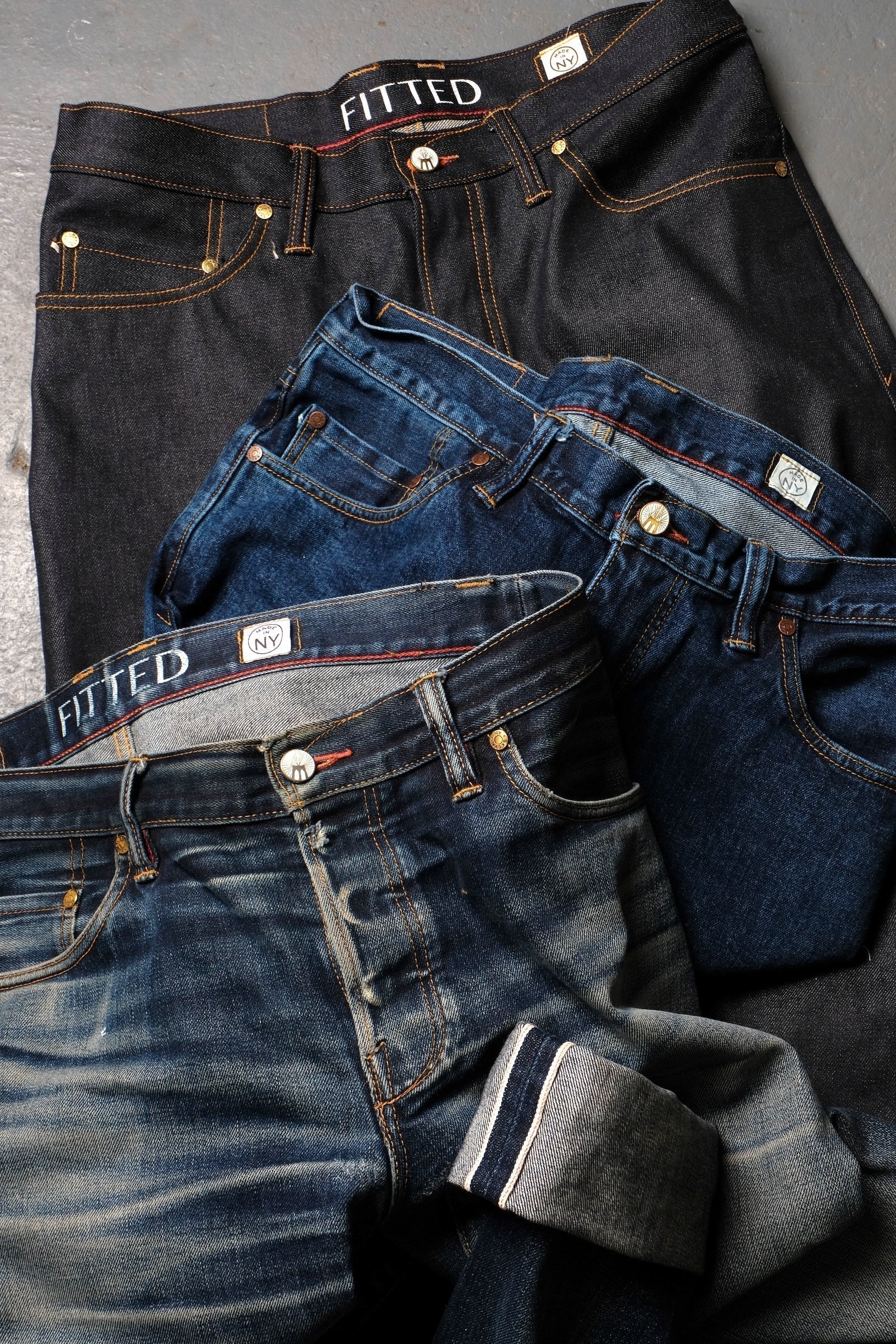
Roll up the cuff on a pair of selvedge jeans and you'll see it — a thin stripe of color running along the outseam. Red, usually. Sometimes gold, green, pink, or — in one recent case I came across — metallic. It's one of the most recognizable signals in the denim world, and for a long time it was treated as a near-guarantee of quality. Serious collectors used the color to identify which mill had woven the fabric. Forums debated the merits of red line vs. gold line vs. pink line with the intensity of wine enthusiasts discussing vintages.
But what is that stripe actually telling you? And does it signal quality, or is it just noise?
To answer that, let's begin at the loom.
Where the Word Comes From
Selvedge is a compression of "self-edge" — a fabric edge that finishes itself during the weaving process rather than requiring a separate finishing step afterward. To understand why that matters, you need to understand the difference between the two types of looms that have defined denim history.
A shuttle loom — the older technology, the one that produces selvedge — uses a single wooden shuttle, called a pick, that carries the weft yarn back and forth across the face of the loom. The shuttle travels from one side, interlaces with the vertical warp threads, reaches the opposite edge, and gets knocked back by a mechanized arm to begin the return journey. Because the shuttle loops the weft yarn continuously — never cutting it at the edge — the fabric seals itself on both sides as it's woven. No raw edge. No fraying. The selvedge is a byproduct of how the loom works, not something applied afterward.
The projectile loom — the machine that largely replaced shuttle looms in most factories around the world from the late 1950s onward — works differently. Instead of a single continuous shuttle, it fires individual weft threads across the face of the loom, cutting each one at the edge when it arrives. The result is a raw, fraying edge that requires an overlocked or bound finish to prevent unraveling. Projectile looms produce fabric roughly twice as wide as shuttle looms — 60 inches vs. roughly 30 — and weave at a fraction of the time. For manufacturers chasing volume, the math was obvious. Shuttle looms were expensive, slow, and required skilled operators. By the mid-1960s, most American denim mills had made the switch.
Japan, as we explored in DU 004: How Japan Saved Raw Denim, largely didn't. The shuttle looms stayed. And what Japanese mills discovered — or rather, preserved — is that the choice of loom isn't just an operational decision. It affects the fabric itself.
Selvedge comes from the term "self edge".
It's a self finished edge of fabric —
that can only be woven on a shuttle loom.
Symbol or Substance? The Deeper Question
Here's the question worth asking honestly: is selvedge a genuine marker of quality, or has it become a symbol — a shorthand that collectors and enthusiasts use as a proxy for something that doesn't necessarily follow from the edge itself?
The answer is both, and it's worth being precise about how.
You can have selvedge denim that isn't particularly special. The self-finished edge alone doesn't guarantee anything. There are shuttle loom fabrics that are mediocre, and there are projectile loom fabrics — wide goods — that are genuinely beautiful and will fade very nicely. The edge is not a definitive sign of quality.
But here's what's also true: the best denim I have ever worked with — the fabrics with the most depth, the most character, the most interesting fading behavior — has come from shuttle looms. And that's not a coincidence.
Shuttle looms weave slowly — 130 to 150 picks per minute versus 600 to 1,000 on a projectile loom — under lower tension and across a smaller face. This does two things simultaneously. First, it preserves yarn character: slubs, neps, and the natural irregularities in the fiber survive the weaving process rather than being pulled straight by the force of a faster machine. Second, the narrower fabric width — roughly 30 inches on a shuttle loom versus 60 on a projectile loom — allows the loom to produce a denser weave per square inch. The result? Lower tension and denser construction. That's why selvedge looms can produce fabrics with character and depth.
Some of the most extraordinary fabric I've handled has come from Toyoda G3 looms — vintage Japanese shuttle looms that produce an exceptionally pebbled, textured cloth that I've never seen replicated on modern equipment. These machines are old, slow, and require craftspeople who understand them intimately. They produce something that faster machines simply cannot.
The ceiling for what denim can be has consistently
been reached on shuttle looms. That's not sentiment.
That's decades of knowledge poured into a fabric.
So the honest answer is this: selvedge is a reliable signal, but not a guarantee. The edge tells you the fabric was woven on a shuttle loom that can do something special. Whether that shuttle loom produced something exceptional depends on the mill, the cotton, the yarn construction, the dyeing process, and the hands that operated it. But if you're looking for the ceiling — for the most character a piece of denim can carry — that ceiling has consistently been reached on shuttle looms.
So a selvedge edge is a start. But what's actually intentionally put into the fabric is what matters.
Raw vs. Selvedge — Clearing Up the Confusion
These two terms get used interchangeably so often that experienced denim buyers will conflate them. But they're answering different questions.
Raw describes the finishing — or the absence of it. As we covered in DU 101: What is Raw Denim?, raw denim has not been pre-distressed, and it comes in two forms: sanforized and unsanforized. It's a beautiful canvas of blue that's ready to age with its owner.
Selvedge describes construction — specifically, how the fabric was woven. It tells you a shuttle loom was used, producing a self-finished edge. It says nothing about what happened to the fabric after it left the loom.
The logical consequence of keeping these definitions separate:
- You can have raw denim that is not selvedge — woven on a projectile loom but never washed or distressed.
- And you can have selvedge denim that is not raw — woven on a shuttle loom, then enzyme washed, stonewashed, or otherwise pre-distressed.
In practice, the vast majority of selvedge denim is raw, and the raw denim community has a strong and well-founded preference for selvedge. But the two terms are not synonymous.
Selvedge describes how denim was woven.
Raw describes that it wasn't distressed after the loom.
They often travel together — but they're not the same thing.
The Japanese Loom Story — And Why It's More Interesting Than the Myth
You may have read in other corners of the internet that Japanese mills acquired their shuttle looms from American factories after the US shifted to projectile production in the 1960s. It's a compelling story: American craftsmanship handed off to Japanese stewards who preserved it better than we did. The only problem? It almost certainly isn't true.
The evidence against it is pretty well documented. Cone Mills — whose White Oak plant in Greensboro, North Carolina was the gold standard of American selvedge production — has stated that any Draper looms rendered surplus in the 1980s went to scrap, not to export. Researchers who have visited major Japanese mills report never seeing a Draper loom in operation. The story appears to trace back to a single source: Hidehiko Yamane, founder of Evisu, who around 2000 claimed to have brought a Levi's loom back to Japan. When it was pointed out that Levi's had never owned looms, the story shifted to "a loom from an American mill." The correction didn't travel as far as the original claim.
The accurate history is less romantic but more interesting. Japan was already a major textile producer long before denim arrived — Toyoda Automatic Loom Works, the predecessor to Toyota, had been building shuttle looms domestically since the early twentieth century. When American brands shifted to projectile looms for volume reasons in the 1960s, Japanese mills didn't need to import the old American equipment. They had their own. What they chose to do with it — preserving and refining shuttle loom technique while the rest of the world moved on — was the meaningful decision. The craft wasn't inherited from America. It was cultivated independently, in parallel, and eventually surpassed what American mills had been doing.
We explored this history in depth in DU 004: How Japan Saved Raw Denim, including the story of indigo's deep roots in Japanese textile culture long before Western denim arrived in DU 001: Indigo Around the World. If you want to understand why Japanese selvedge denim became the standard it is today, that's where to start.
Japan didn't inherit the shuttle loom tradition from America.
It cultivated its own — and eventually set the standard
the rest of the world measures itself against.
The Selvedge ID — What That Stripe Actually Means
Back to that colored stripe on the outseam.
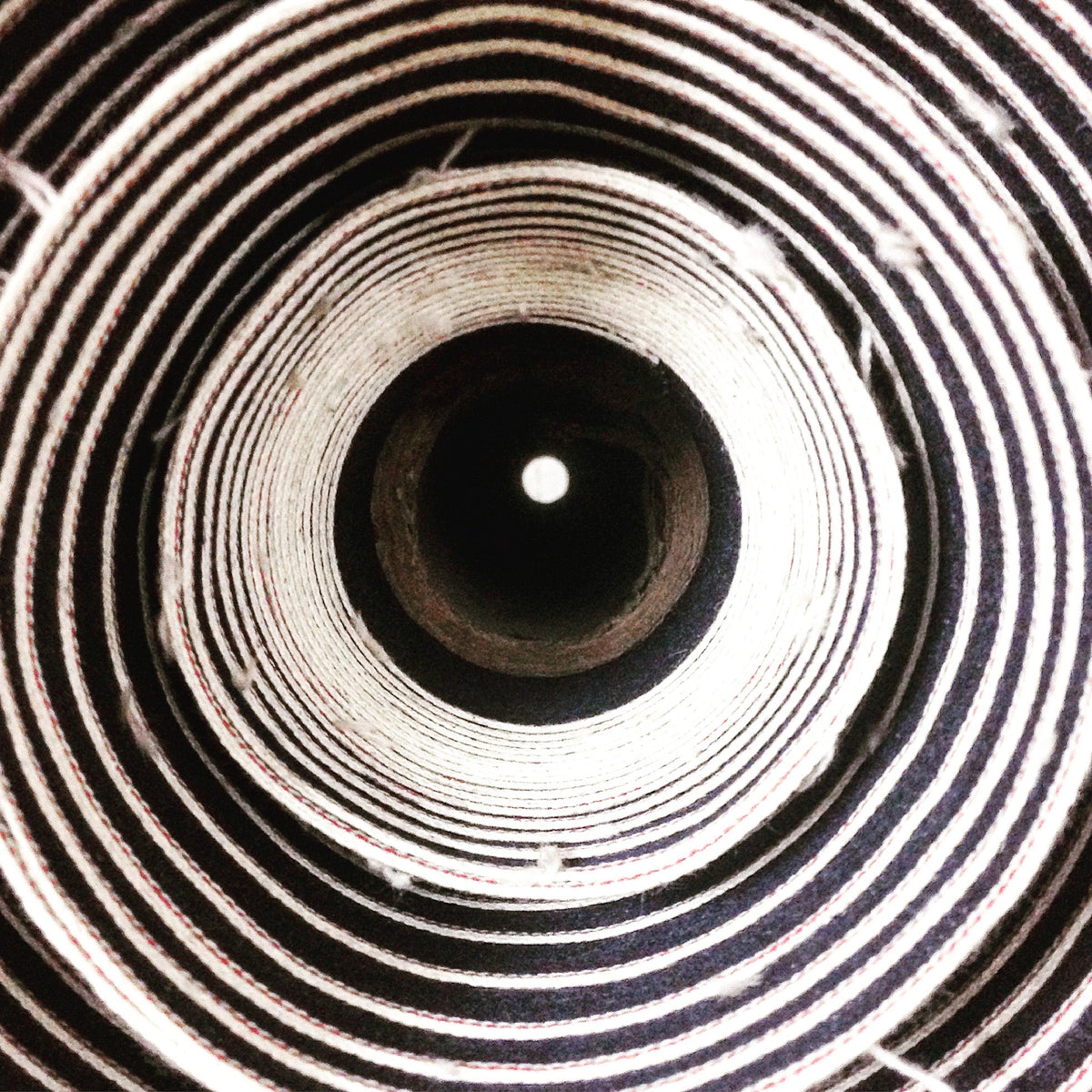
The selvedge ID — the stripe woven into the self-finished edge — has a history as a mill signature. Each manufacturer used a specific color to identify their fabric, and serious collectors of vintage denim used these colors to trace the provenance of their finds. Red line Cone Mills. Gold line Cone. Greenish cast on certain Japanese fabrics. The stripe was, in effect, a maker's mark woven into the construction of the cloth.
This is no longer canonical. Most mills today default to red as a base, but experiment freely — with other colors, with multiple stripes, with entirely unexpected treatments. Recently I came across a selvedge ID with a metallic finish, which I'd never seen before. I have another fabric from Burkina Faso where the selvedge ID carries the colors of the national flag. It's a beautiful expression of identity — and a reminder that the tradition is alive enough to keep evolving. But it no longer tells you definitively where the denim was milled the way it once did.
What the selvedge ID does still reliably signal is this: you're looking at selvedge construction. The stripe exists because the edge was woven rather than cut. That's real information, and it's still worth knowing.
For collectors and enthusiasts, the ID remains a point of joy — a detail that rewards attention, that distinguishes one fabric from another, that connects a pair of jeans to a specific mill and a specific tradition. It's the kind of detail that makes the denim world genuinely interesting rather than merely transactional.
What a Maker Notices
When I'm in the workshop cutting and sewing selvedge fabric, what strikes me first is texture. A well-made selvedge denim often has depth in a way that's immediately apparent to the hand. Sometimes it's a pronounced vertical slub — an irregularity in the yarn that creates a subtle ribbing in the finished fabric. Sometimes it's horizontal, or a nep that gives the surface a slight directional quality. Sometimes it's an extraordinarily even weave, almost architectural in its consistency. But there's always a sense of intention — of fabric that was made thoughtfully rather than produced at speed.
There's something I've thought about for a long time that I'll try to put into words here. A great comic leaves something behind after she walks off stage. The laughter fades, the room settles, but something from her presence lingers. The experience she created has a life of its own; an emotional sediment that lives on after she is gone.
Great denim does something similar. You take it off at the end of the day and the experience stays with you — the weight, the way it drapes, the texture. That quality is hard to define technically, but it's unmistakable once you've felt it, and it tends to be most pronounced in the best selvedge fabrics. There is something about great selvedge denim that feels like more than the sum of its parts.
Great denim leaves something behind. You take it off at the end of the day and the experience stays with you — the weight, the drape, the texture. That's not marketing. That's craftsmanship.
This is what I'm reaching for when I source fabric for FITTED Underground. The intangible beyond the tangible.
Why It Matters to You
Should you insist on not just raw denim, but selvedge raw denim? Probably — but you don't have to.
There is genuinely good wide goods denim out there that will develop beautiful fades and reward long wear. The selvedge edge is not a hard prerequisite for a great raw denim experience. And if budget is a constraint, a well-made pair of raw non-selvedge jeans can be a better choice than a mediocre pair of selvedge.
That said, part of the joy of raw denim is participating in a community that has spent decades thinking carefully about what makes a great pair of jeans. Within that community, the selvedge edge remains a meaningful shorthand — a signal that tends to hold water. It points toward shuttle loom construction, which points toward a certain kind of fabric quality and character that's genuinely difficult to find elsewhere.
If you're investing in a pair you intend to wear for the next five years and develop into something personal, I'd say selvedge is the right choice. The fabric has been made for this very purpose.
If you're ready to make that choice, you may want to skip to DU 201: How to Buy Your First Pair of Raw Denim Jeans, which walks through the full decision.
What Comes Next
Now that you understand what selvedge is and how it relates to raw denim, the next foundational question trips up almost every beginner: if raw denim comes in sanforized and unsanforized versions, what actually happens when you wash them — and how do you choose between them? It's a more consequential decision than most people realize.
← Previous: DU 101 — What is Raw Denim? | Next: DU 103 — Sanforized vs. Shrink to Fit →
Core Curriculum
Complete the core curriculum by reading these essential classes.
- DU 101 — What is Raw Denim?
- DU 102 — What is Selvedge Denim?
- DU 104 — Denim Weight Explained
- DU 201 — How to Buy Your First Pair of Raw Denim Jeans
- DU 204 — How Much to Spend on Raw Denim
- How It Works — FITTED Underground
Eric Steffen is the founder of FITTED Underground, a custom jeans and raw denim workshop at 108 Bayard Street in Williamsburg, Brooklyn. He has been making jeans by hand since 2014. Denim University is his attempt to share everything he's learned — about the history, the craft, and the culture behind the world's most enduring garment.