
DU 105: The Build - Every Part of a Jean, Explained
Summary
A well-made pair of jeans is a remarkably complex object — over 20 individual components, each with a name, a function, and in most cases a history stretching back to the American West in the 1870s. The yoke shapes the seat. The arcuate stitch is the oldest apparel trademark still in use. The coin pocket was designed for a pocket watch. Knowing the anatomy of a pair of jeans makes you a more educated buyer — and deepens the experience of wearing them.
Q&A
What is the yoke on a pair of jeans?
The yoke is the horizontal panel running across the back of the jean, below the waistband and above the seat. It looks decorative — a V-shape or chevron — but it's structural. In a tailored trouser, the three-dimensional shape of the seat is created with a dart. In jeans, that dart is slashed open, spread apart, and flattened into its own separate pattern piece. The yoke is, in essence, a dart that has been exploded and elevated into a panel. Get the yoke geometry wrong and the seat will never fit correctly.
Why do jeans have a coin pocket?
The small pocket set inside the right front pocket was designed to hold a pocket watch. Levi's included it in the original 1873 patent design for the working men who wore their jeans in the mines and fields of the American West. Nobody carries a pocket watch anymore, making it entirely vestigial — but removing it would look wrong. It has been on every five-pocket jean for 150 years and it belongs there.
What is the arcuate stitch?
The arcuate is the decorative arc stitching on the back pockets of jeans. Jacob Davis added it to the original Levi's design in 1873 to distinguish them from imitators — making it the oldest apparel trademark still in continuous use in the world. Every brand has its own version. At FITTED Underground, the arcuate is a simplified representation of the Brooklyn Bridge.
What is a chain stitch hem and why does it matter?
A chain stitch hem is sewn on a specialized machine — a Union Special or equivalent — rather than a standard lock stitch machine. As the denim shrinks and distorts with wear and washing, the chain stitch produces a characteristic roping and puckering effect at the hem that raw denim enthusiasts prize. The roping comes from the uneven tension applied to the fabric as it's fed into the machine — either through a folder or a skilled operator manipulating the fabric by hand.
What is crotch blowout and can it be repaired?
Crotch blowout is wear-through at the crotch point — the junction where the inseam, crotch seam, and seat seam converge. It's the highest-stress point in the entire garment, pulled in more directions simultaneously than anywhere else, and it's typically where a first failure occurs after years of hard wear. Yes, it can be repaired — either with a patch or through a process called darning, which reinforces the area without adding bulk.
Test Your Knowledge
Click each answer to reveal whether it's correct.
1. What is the structural purpose of the yoke?
A. To reinforce the waistband against belt stress
❌ Incorrect. Belt stress is handled by bartacks at the belt loop attachment points. The yoke's job is structural shaping of the seat.
B. To provide a surface for the leather patch
❌ Incorrect. The leather patch sits on the waistband, not the yoke. The yoke is a structural pattern piece that shapes the seat.
C. To replace the dart used in tailored trousers — shaping the seat in three dimensions
✓ Correct. In tailored trousers, the seat is shaped with a dart — a wedge of fabric pinched and sewn shut. In jeans, that dart is slashed open, spread apart, and flattened into its own pattern piece: the yoke. It looks decorative but it's entirely structural. Get the yoke geometry wrong and the seat will never fit correctly.
D. To anchor the center back seam to the waistband
❌ Incorrect. The center back seam runs through the yoke but the yoke's primary purpose is shaping the seat — it's a structural pattern piece derived from the dart used in tailored trousers.
2. What was the original purpose of the coin pocket?
A. To hold coins for pay phones
❌ Incorrect. Pay phones didn't exist in 1873. The coin pocket was designed to hold a pocket watch for miners and field workers in the American West.
B. To hold a pocket watch
✓ Correct. Levi's included the coin pocket in the original 1873 patent design specifically to hold a pocket watch — the standard timekeeping device for working men in the mines and fields of the American West. Nobody carries a pocket watch anymore, making it entirely vestigial. But removing it would look wrong, and it's been on every five-pocket jean ever since.
C. To store tobacco
❌ Incorrect. The coin pocket was designed for a pocket watch. It is exactly the right size for a watch face — which is about all it ever held anyway.
D. To carry a folding knife
❌ Incorrect. A folding knife would be too large for the coin pocket. It was designed specifically for a pocket watch and sized accordingly.
3. Why was the crotch rivet removed from the original Levi's patent design?
A. It caused the seam to fail prematurely under stress
❌ Incorrect. The rivet was doing its structural job fine. The problem was entirely comfort-related, not structural failure.
B. It was too expensive to produce at scale
❌ Incorrect. Cost was not the issue — copper rivets were already being used throughout the garment. The removal was driven entirely by wearer complaints.
C. It interfered with the chain stitch hem machine
❌ Incorrect. The crotch rivet had nothing to do with the hem machine. It was positioned at the crotch point, far from the hem.
D. It heated uncomfortably when wearers sat beside a campfire
✓ Correct. The crotch rivet was removed after complaints that it heated uncomfortably when wearers sat beside a campfire — one of the more specific problems in the history of workwear design. It had been included for structural reinforcement at the highest-stress point in the garment, but the campfire problem ended its run.
4. What makes the arcuate stitch historically significant?
A. It is the oldest apparel trademark still in continuous use in the world
✓ Correct. Jacob Davis added the arcuate stitching to the original Levi's design in 1873 to distinguish their jeans from imitators. It has remained in continuous use ever since — making it the oldest apparel trademark still active in the world. Every brand has its own version. At FITTED Underground, it's a simplified representation of the Brooklyn Bridge.
B. It was the first use of decorative stitching in workwear
❌ Incorrect. Decorative stitching long predates the arcuate. Its significance is that it became the oldest apparel trademark still in continuous use — not that it was the first decorative stitch.
C. It was patented alongside the copper rivet in 1873
❌ Incorrect. The 1873 patent covered the copper rivet reinforcement specifically. The arcuate was a brand distinction, not a patented element.
D. It was originally used to reinforce the pocket against tearing
❌ Incorrect. The arcuate is decorative, not structural. Pocket reinforcement is handled by the copper rivets at the pocket corners — Jacob Davis's original innovation.
← Previous: DU 104 | ↑ Denim University | Next: DU 106 →
By Eric Steffen
Founder / Maker
FITTED Underground
Most people wear jeans every day without ever really looking at them. They're "just jeans" — you put them on and go about your life. But pick up a well-made pair of raw denim and examine them, and what you're holding is a remarkably complex, intricately designed object. Over 20 individual components, each with a name, a function, and in most cases a history stretching back to the American West in the 1870s. The coin pocket alone has a story. So does the arcuate stitch. The yoke — the piece that gives the entire garment its shape — is one of the most elegant solutions in all of workwear, and almost nobody knows what it is or how it works.
Knowing the anatomy of a pair of jeans makes you a more educated consumer — and will enrich your experience of owning and wearing your jeans. We'll give you the vocabulary and details to have a real conversation about what separates a well-made pair from everything else on the market.
The sections below walk through each component from front to back, top to bottom.
The Front

1. Front Panel
Before the pockets, the fly, the rivets, or any of the details that make a pair of jeans visually interesting are completed, there is the front panel. It's the largest single piece of fabric on the front of the garment — running from just below the waistband all the way to the bottom hem — and it's so foundational that it's easy to take for granted. But everything else on the front of the jean is built around it or into it.
The front panel is primarily a patternmaking problem. Its shape determines the front rise — how high the jean sits on the body — and how the garment drapes from the waist down. It governs the relationship between the waist and the hip, and whether the side seam runs perfectly straight from waistband to hem, which is especially critical on a selvedge pattern to preserve the selvedge ID. Get the front panel right and you have a foundation for a great-fitting jean. Get it wrong and no amount of beautiful hardware or careful stitching will compensate. The front panel is where fit is won or lost before a single detail is added.
At FITTED Underground, I made our jean pattern from the ground up, and we've been iterating on it for over a decade. It's a process of continual innovation and improvement.
2. Waistband
The horizontal band running across the top of the jean. On a selvedge pair, the waistband is usually cut on the straight grain (parallel to the selvedge edge) to maximize yield, given that selvedge denim is only ~30" wide. (Fabric woven on a projectile loom are typically ~60".) A signifier of a well-made jean is if the bottom of the waistband is sewn with a chainstitch and the top of the waistband is sewn with a lockstitch (normal stitch). This serves two functions: First, a chainstitch lower on the garment is less likely to rub directly against skin and cause irritation. Second, because of how the knot is closed, a chainstitch can relax and expand slightly with wear while a lockstitch cannot. This structure allows the bottom of the waistband to stretch slightly more than the top, mimicking a contour waistband — and a superior fit.
3. Waistband Button
The closure at the top of the fly. Waistband buttons are typically "27 ligne", or 17mm. A ligne (pronounced "leen") is a term that dates to the watchmaking industry in pre-metric France. Paris was the capital of button manufacturing in the 17th century, and that archaic measurement system is still used in the industry today. In my opinion, the waistband button has two functions: First, not fall off. In an early version of our jeans, we made thousands of buttons by a reputable button company — and they still fell off! The solution was to switch to a nylon-threaded prong that secured the button head much better. Second, add provenance that helps define the brand. It took me six months to design our Brooklyn Bridge button, but it was worth the iterations. Customers often cite it as one of their favorite details on our jeans.
4. Belt Loops and Bartacks
Five belt loops is standard on a five-pocket jean, positioned at the side seams, center back, and flanking the front pockets. We use six, doubling up the belt loop at the center back to help prevent gapping for athletic body types who wear belts. Each loop is attached at top and bottom with a bartack — a dense cluster of stitches that reinforces the attachment point against the stress of a belt pulling repeatedly in one direction. Without a bartack, belt loops will fail at the attachment point quickly. The bartack is one of those construction details that separates workwear from fashion — invisible until it's missing.
5. Coin Pocket (Watch Pocket)
The small pocket set inside the right front pocket. Originally designed to hold a pocket watch — Levi's added it to the original 1873 patent design for the working men who wore their jeans in the mines and fields of the American West. Nobody carries a pocket watch anymore, which makes the coin pocket entirely vestigial. And yet removing it would look wrong. It has been on every pair of five-pocket jeans for 150 years and it belongs there. It is the fifth pocket on a five-pocket jean. It's part of the show. On a selvedge pair it often includes a selvedge peek-out, is reinforced with a rivet at each corner, and is just large enough to be useful for a key or a few coins — which is about all it ever held anyway.
6. Front Pockets
Two styles of front pocket construction exist in the denim world. The J-pocket — named for its curved shape — is the classic workwear construction: a single piece of fabric cut in a continuous arc from the waistband into the side seam, creating a deep, functional pocket. The slash pocket cuts straight across at an angle, producing a cleaner, more European line. J-pockets are the traditional choice for raw denim and the one we use at FITTED Underground. Inside the visible pocket opening is the pocket bag — the lining fabric that forms the actual pocket. On quality construction this bag is substantial. Typical pocketing material is 4–5oz. We use 8oz on most of our jeans — and 11oz pocketing on our heavyweight jeans, which could almost be a jean itself.
7. Fly
The closure running from the waistband to the crotch point. Two options: button fly or zip fly. The button fly is the older construction — the original Levi's patent jeans used buttons because the zipper hadn't been invented yet, and the button fly has remained the preferred choice for raw denim purists ever since. We use pure brass buttons milled in Connecticut that patina with age. The zip fly is more practical for daily life and there's nothing wrong with it. This is a matter of preference and tradition rather than quality. Top zipper brands include: YKK (Japan, founded 1934), the global standard — roughly half of all zippers made in the world are YKK. Talon (USA, founded 1893), the original — vintage Talon zippers are one of the details collectors look for on original 501s. Riri (Switzerland/Italy, founded 1936), the luxury tier — often called the Rolls-Royce of zippers.
8. Rivets
Copper rivets placed at the stress points of the pockets — the corners of the coin pocket, the base of the front pocket openings. This was Jacob Davis's original innovation in 1873, the invention that prompted his partnership with Levi Strauss and produced the first patented pair of blue jeans. The rivet is set through two layers of fabric and peened over on the reverse side, creating a mechanical fastener that prevents pocket corners from tearing under the stress of regular use. On the original patent jeans there was also a crotch rivet at the junction of the inseam and seat seam — included for structural reinforcement at the highest-stress point in the garment. It was removed after a series of complaints that it heated uncomfortably when wearers sat beside a campfire, which is one of the more specific problems in the history of workwear design.
9. Front Rise
The distance from the top of the waistband to the crotch seam at the front. Rise is one of the most important fit dimensions in a pair of jeans and one of the least discussed outside of tailoring circles. A higher rise sits at or near the natural waist, provides more coverage in the seat and belly, and tends to be more comfortable for most body types across a full range of movement. A lower rise sits below the natural waist and requires more precise fit through the seat and thigh to avoid pulling or gapping. Traditional raw denim runs higher in the rise than contemporary fashion denim — closer to the original workwear proportions of the 1940s and 1950s. Understanding your rise preference before you buy is one of the most useful things you can do as a raw denim buyer.
The Back


10. Rear Panel
The rear panel is the back equivalent of the front panel — the largest single piece of fabric on the back of the garment, running from the bottom of the yoke all the way to the hem. The yoke sits above it, the back pockets are applied on top of it, and the center back seam runs down its middle. But like the front panel, the rear panel is fundamentally a patternmaking piece: it determines how the garment shapes the seat, how the back rise relates to the front, and how the jean drapes on the body from behind.
The front and rear panels are adjusted in tandem. You cannot arrive at a great fit by perfecting one without accounting for the other. At FITTED Underground, getting the front-to-rear panel relationship right is the central patternmaking challenge of every new design.
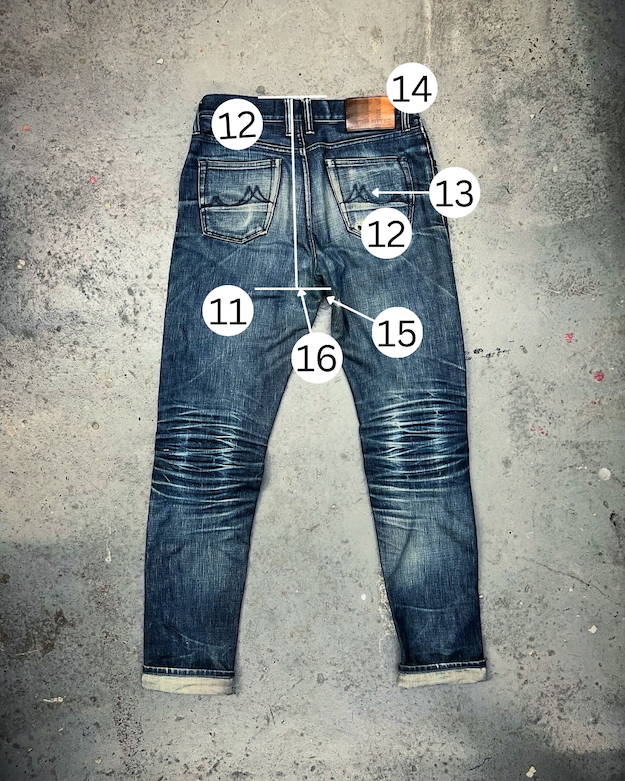
11. Yoke
The yoke is one of the most important and least understood pattern pieces in a pair of jeans. It is the horizontal panel running across the back of the garment from side seam to the center back, sitting below the waistband and above the seat. Most wearers see it as a decorative element — a V-shape or chevron that adds visual interest to the back of the jean. It is not decorative. It is structural.
In a tailored trouser — a pair of chinos or dress pants — the three-dimensional shape of the seat is created with a dart: a wedge of fabric pinched, sewn shut, and trimmed away, pulling the flat fabric into the curved form required to follow the contours of a human body. In a pair of jeans, that dart is handled differently. Instead of being sewn shut and hidden, the dart is slashed open, spread apart, and flattened into its own separate pattern piece. The yoke is, in essence, a dart that has been exploded and elevated into a panel.
Getting the design of the yoke right is important. We went through years of small iterations until we landed on a geometry that checked all the boxes. The trick? We incorporate a slight curve into the vertical portion of the yoke at the center back. There's no substitute for experience.
12. Back Pockets
Two patch pockets applied directly to the back panels of the jean — they are separate pattern pieces that sit on top of the rear panel, not cut into it. The size, placement, and angle of the back pockets affect both the visual aesthetic and the apparent shape of the seat — pockets placed lower and wider tend to make the seat look larger and flatter; pockets placed higher create the impression of a more fitted seat. On our jeans, the inside of each back pocket is lined with a separate pocket bag — folded over to create a hidden break that fades in like the roadway of the Brooklyn Bridge.
13. Arcuate Stitching
The decorative arc stitching on the back pockets. Jacob Davis added this in 1873 to distinguish Levi's jeans from imitators, making it the oldest apparel trademark still in continuous use in the world. Every brand has its own version — a double arc, a single line, a more complex pattern, or in some cases nothing at all, which is its own kind of statement. Our arc is a simplified representation of the Brooklyn Bridge. Once you see it, you can't unsee it.
14. Leather Patch
Applied to the outside of the waistband at the center back, the leather patch carries brand information and sometimes size details. Originally it was functional — a durable surface for information that needed to survive the hard conditions of workwear use. Now as much a brand statement as a practical element. We source our leather from Pennsylvania and stamp it with our logo in-house. Our logo is an outline of the borough of Brooklyn made into a dragon. I call it the Brooklyn Dragon. My mom, who is from Brooklyn, calls it the Brooklyn Turkey.
15. Center Back Seam
The seam running from the waistband down through the seat to the crotch point. On a well-made pair of raw jeans this seam is sewn using a flat felling machine or a feed-off-the-arm machine. Sewing it is probably the most difficult construction operation on a pair of jeans. Not only is there a curved surface at the beginning of the stitch, but the felled seams at the yoke result in sewing down sixteen layers of fabric at once. It takes years of practice and determination to sew this stitch correctly.
16. Crotch and Crotch Point
The crotch seam curves from the front rise through the seat, and the crotch point is where the inseam, crotch seam, and seat seam all converge in a single junction. It is the highest-stress point in the entire garment — the place where the fabric is pulled in more directions simultaneously than anywhere else. The area around the crotch point is typically where a first blowout will happen as a result of the constant wear, tear, and friction generated whenever you take a step in your jeans. It is uninspiringly called: crotch blowout. The good news — it can be fixed with a patch or through a process called darning.
Construction Details
17. Side Seam (Outseam)
Runs from the waistband to the hem along the outside of the leg. On raw selvedge jeans the outseam is where the selvedge edge of the fabric lives — the self-finished edge produced by the shuttle loom, as covered in DU 102: What is Selvedge Denim?. The jean is cut so that this edge runs along the outseam rather than being trimmed away, and on many raw jeans the outseam is left open rather than folded and pressed, allowing the selvedge edge to remain visible. This is why the selvedge ID is visible when you roll up the cuff — you're seeing the actual edge of the fabric as it came off the loom.
18. Selvedge ID
The colored stripe woven into the self-finished edge of the fabric, visible on the outseam when the cuff is rolled. Red is the most common color. Historically each mill used its own color as a signature, though as discussed in DU 102 this is less strictly observed today. The ID is proof of selvedge construction — it exists because the edge was woven rather than cut. For collectors and serious enthusiasts it remains a meaningful detail; for most wearers it's a quiet marker of quality hiding inside the outseam.
19. Inseam
Runs from the crotch point to the hem along the inside of the leg. On quality construction the inseam is sewn with a felled seam — the fabric folded over itself for durability — or chain-stitched for character. The inseam length is one of the most critical measurements for fit, and on unsanforized denim it requires particular attention: as we covered in DU 103: Sanforized vs. Shrink to Fit, unsanforized denim will shrink two or more inches in the inseam on first soak, which is why we always cut the inseam long on kibata garments.
20. Chain Stitch Hem
The hem of a quality raw jean is finished with a chain stitch rather than a standard lock stitch. The chain stitch is produced on a specialized machine — a Union Special or equivalent — and creates a characteristic roping and puckering effect as the denim shrinks and distorts with wear and washing. But the actual roping isn't just from the chain stitch — it's from the uneven tension applied to the fabric as it gets fed into the machine. This tension can be generated by using a folder, or if a skilled operator knows how to manipulate the fabric correctly.
21. Hardware Finish
The collective term for the metal elements — buttons, rivets, and zipper pull if present. On traditional raw denim the standard finish is copper or brass: warm-toned, develops a patina with wear rather than corroding or dulling. Silver-toned hardware is less traditional but not wrong — it reads as more contemporary. The hardware finish is a design choice that contributes to the overall character of the garment in ways that are easy to overlook when new and increasingly satisfying as the metal ages alongside the denim.
The Garment as a Whole
Now you know every part of the garment by name. The coin pocket that nobody uses. The arcuate stitch that's been on every Levi's for 150 years. The yoke that gives the seat its shape. The front and rear panels that make fit possible before a single detail is added. These aren't arbitrary details — each one is the answer to a specific problem that somebody solved, usually in the nineteenth century, and that solution has proven durable enough to survive unchanged into the present.
That continuity is part of what makes raw denim worth paying attention to. You're not just wearing a pair of jeans. You're wearing a design that has been refined over 150 years and that carries the evidence of your own life in its fades and creases. Understanding the parts of the garment is the first step toward understanding why it matters.
What Comes Next
Before the 200-level buying articles begin, one more reference piece: a plain-language denim dictionary of the terms you'll encounter throughout this curriculum and across the broader raw denim world. Consider it a companion to everything that comes before and after it.
← Previous: DU 104 — Denim Weight Explained | Next: DU 106 — Denim Dictionary →
Core Curriculum
Complete the core curriculum by reading these essential classes.
- DU 101 — What is Raw Denim?
- DU 102 — What is Selvedge Denim?
- DU 104 — Denim Weight Explained
- DU 201 — How to Buy Your First Pair of Raw Denim Jeans
- DU 204 — How Much to Spend on Raw Denim
- How It Works — FITTED Underground
Eric Steffen is the founder of FITTED Underground, a custom jeans and raw denim workshop at 108 Bayard Street in Williamsburg, Brooklyn. He has been making jeans by hand since 2014. Denim University is his attempt to share everything he's learned — about the history, the craft, and the culture behind the world's most enduring garment.