
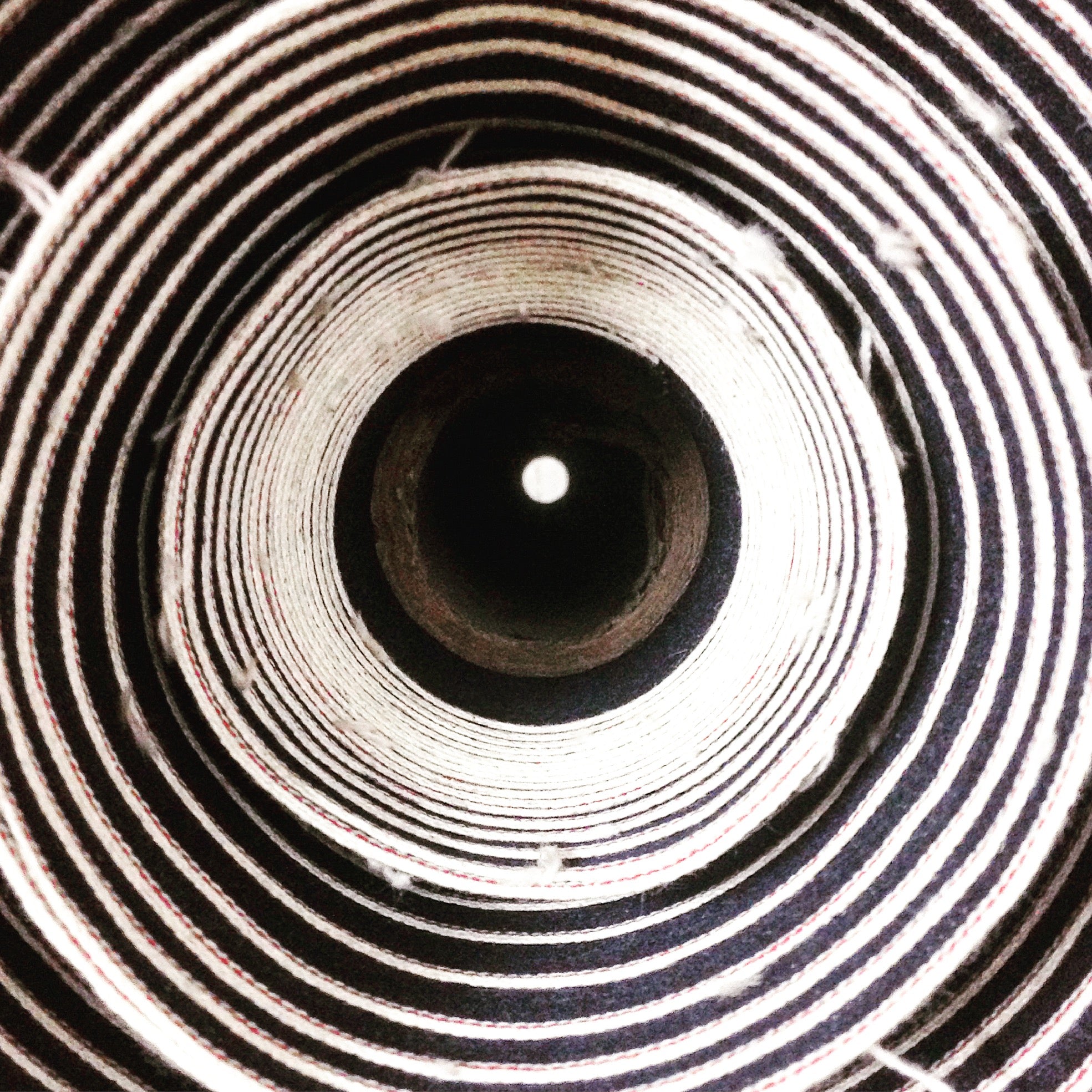
DU 102: What is Selvedge Denim?
Class Notes (TL;DR)
Selvedge denim is one of the worlds most beautiful — and least understood — fabrics. It's prized for its fade potential and character. In DU 102, we dive into the fundamentals of selvedge denim to give you a solid foundation for understanding what it is, what it isn't — what to look for to find truly premium selvedge denim.
- Selvedge comes from the term "self-edge", referring to the "self finished" edge along the side of selvedge fabrics
- It's a woven fabric made with a shuttle loom that uses a single wooden pique that runs back and forth along the face of the loom
- This motion produces a finished edge — and gives the denim additional character that is hard to replicate on modern looms
- Speaking of modern looms, projectile looms are used to produce wide goods (non selvedge) fabric, which is twice as wide — and woven at more than twice the speed — as selvedge denim; efficient, but they often lack the character and depth of selvedge denim
- The selvedge ID (the colored thread on the side seam) was historically a mill signature; today it is still the telltale sign of selvedge denim, but no longer maps to a specific mill
- Selvedge is a reliable signal of quality, but not a guarantee — the best denim consistently comes from shuttle looms, but the loom alone doesn't make it great
- Pro tip: Raw denim and selvedge are often overlapping, but technically two separate things. One describes how denim was made; the other how denim was finished. Knowing the difference will make you a more educated consumer
← Previous: DU 101 — What is Raw Denim? | Next: DU 103 — Sanforized vs. Shrink to Fit →
By Eric Steffen
Founder / Maker
FITTED Underground
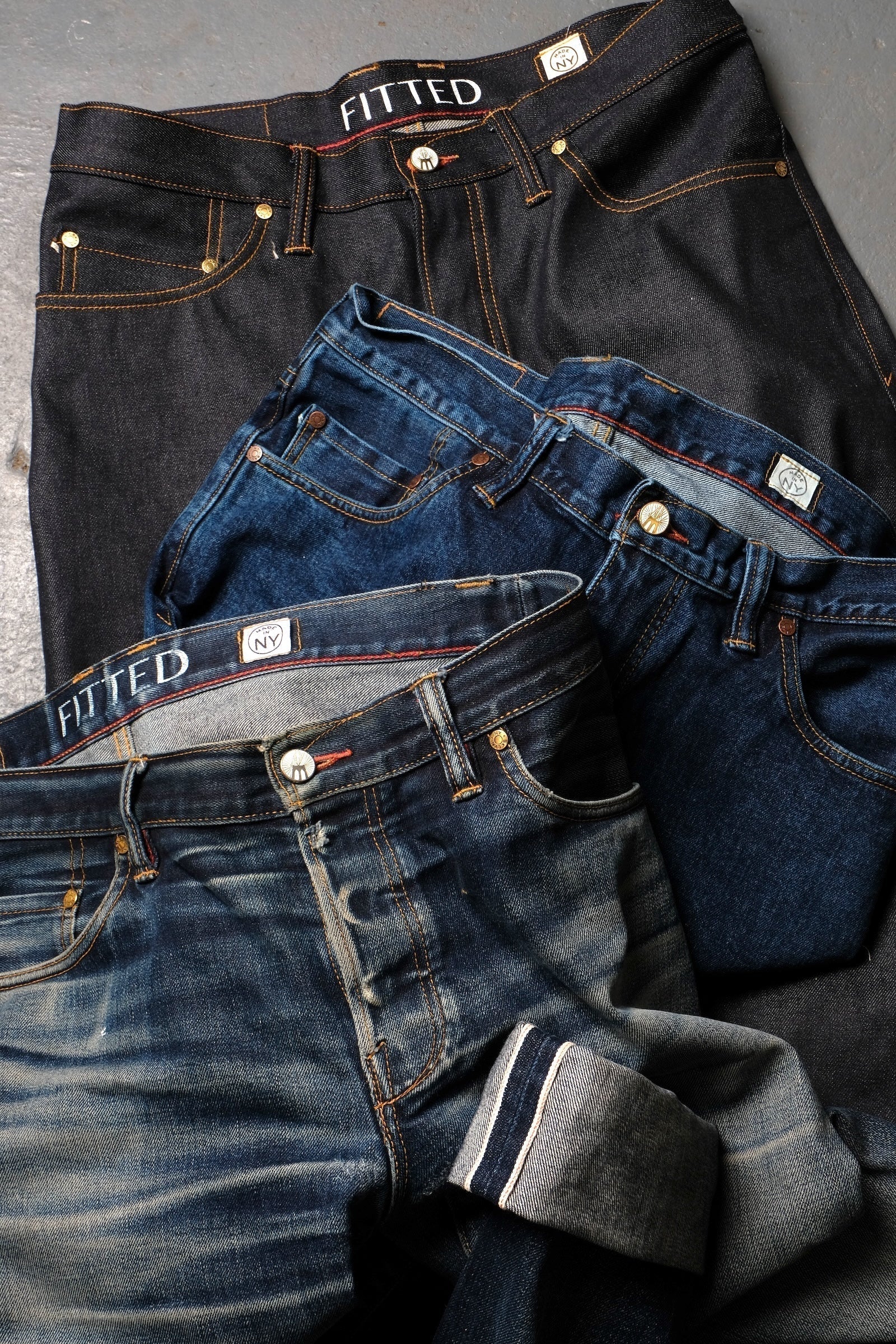
Roll up the cuff on a pair of selvedge jeans and you'll see it — a thin stripe of color running along the outseam. Red, usually. Sometimes gold, green, pink, or — in one recent case I came across — metallic. It's one of the most recognizable signals in the denim world, and for a long time it was treated as a near-guarantee of quality. Serious collectors used the color to identify which mill had woven the fabric. Forums debated the merits of red line vs. gold line vs. pink line with the intensity of wine enthusiasts discussing vintages.
But what is that stripe actually telling you? And does it signal quality, or is it just noise?
To answer that, let's begin at the loom.
Where the Word Comes From
Selvedge is a compression of "self-edge" — a fabric edge that finishes itself during the weaving process rather than requiring a separate finishing step afterward. To understand why that matters, you need to understand the difference between the two types of looms that have defined denim history.
A shuttle loom — the older technology, the one that produces selvedge — uses a single wooden shuttle, called a pick, that carries the weft yarn back and forth across the face of the loom. The shuttle travels from one side, interlaces with the vertical warp threads, reaches the opposite edge, and gets knocked back by a mechanized arm to begin the return journey. Because the shuttle loops the weft yarn continuously — never cutting it at the edge — the fabric seals itself on both sides as it's woven. No raw edge. No fraying. The selvedge is a byproduct of how the loom works, not something applied afterward.
The projectile loom — the machine that largely replaced shuttle looms in most factories around the world from the late 1950s onward — works differently. Instead of a single continuous shuttle, it fires individual weft threads across the face of the loom, cutting each one at the edge when it arrives. The result is a raw, fraying edge that requires an overlocked or bound finish to prevent unraveling. Projectile looms produce fabric roughly twice as wide as shuttle looms — 60 inches vs. roughly 30 — and weave at a fraction of the time. For manufacturers chasing volume, the math was obvious. Shuttle looms were expensive, slow, and required skilled operators. By the mid-1960s, most American denim mills had made the switch.
Japan, as we explored in DU 004: How Japan Saved Raw Denim, largely didn't. The shuttle looms stayed. And what Japanese mills discovered — or rather, preserved — is that the choice of loom isn't just an operational decision. It affects the fabric itself.
Symbol or Substance? The Deeper Question
Here's the question worth asking honestly: is selvedge a genuine marker of quality, or has it become a symbol — a shorthand that collectors and enthusiasts use as a proxy for something that doesn't necessarily follow from the edge itself?
The answer is both, and it's worth being precise about how.
You can have selvedge denim that isn't particularly special. The self-finished edge alone doesn't guarantee anything. There are shuttle loom fabrics that are mediocre, and there are projectile loom fabrics — wide goods — that are genuinely beautiful and will fade very nicely. The edge is not a definitive sign of quality.
But here's what's also true: the best denim I have ever worked with — the fabrics with the most depth, the most character, the most interesting fading behavior — has come from shuttle looms. And that's not a coincidence.
Shuttle looms weave slowly — 130 to 150 picks per minute versus 600 to 1,000 on a projectile loom — under lower tension and across a smaller face. This does two things simultaneously. First, it preserves yarn character: slubs, neps, and the natural irregularities in the fiber survive the weaving process rather than being pulled straight by the force of a faster machine. Second, the narrower fabric width — roughly 30 inches on a shuttle loom versus 60 on a projectile loom — allows the loom to produce a denser weave per square inch. The result? Lower tension and denser construction. That's why selvedge looms can produce fabrics with character and depth.
Some of the most extraordinary fabric I've handled has come from Toyoda G3 looms — vintage Japanese shuttle looms that produce an exceptionally pebbled, textured cloth that I've never seen replicated on modern equipment. These machines are old, slow, and require craftspeople who understand them intimately. They produce something that faster machines simply cannot.
So the honest answer is this: selvedge is a reliable signal, but not a guarantee. The edge tells you the fabric was woven on a shuttle loom that can do something special. Whether that shuttle loom produced something exceptional depends on the mill, the cotton, the yarn construction, the dyeing process, and the hands that operated it. But if you're looking for the ceiling — for the most character a piece of denim can carry — that ceiling has consistently been reached on shuttle looms.
So a selvedge edge is a start. But what's actually intentionally put into the fabric is what matters.
Raw vs. Selvedge — Clearing Up the Confusion
These two terms get used interchangeably so often that experienced denim buyers will conflate them. But they're answering different questions.
Raw describes the finishing — or the absence of it. As we covered in DU 101: What is Raw Denim?, raw denim has not been pre-distressed, and it comes in two forms: sanforized and unsanforized. It's a beautiful canvas of blue that's ready to age with it's owner.
Selvedge describes construction — specifically, how the fabric was woven. It tells you a shuttle loom was used, producing a self-finished edge. It says nothing about what happened to the fabric after it left the loom.
The logical consequence of keeping these definitions separate:
- You can have raw denim that is not selvedge — woven on a projectile loom but never washed or distressed.
- And you can have selvedge denim that is not raw — woven on a shuttle loom, then enzyme washed, stonewashed, or otherwise pre-distressed.
In practice, the vast majority of selvedge denim is raw, and the raw denim community has a strong and well-founded preference for selvedge. But the two terms are not synonymous.
The Selvedge ID — What That Stripe Actually Means
Back to that colored stripe on the outseam.
The selvedge ID — the stripe woven into the self-finished edge — has a history as a mill signature. Each manufacturer used a specific color to identify their fabric, and serious collectors of vintage denim used these colors to trace the provenance of their finds. Red line Cone Mills. Gold line Cone. Greenish cast on certain Japanese fabrics. The stripe was, in effect, a maker's mark woven into the construction of the cloth.
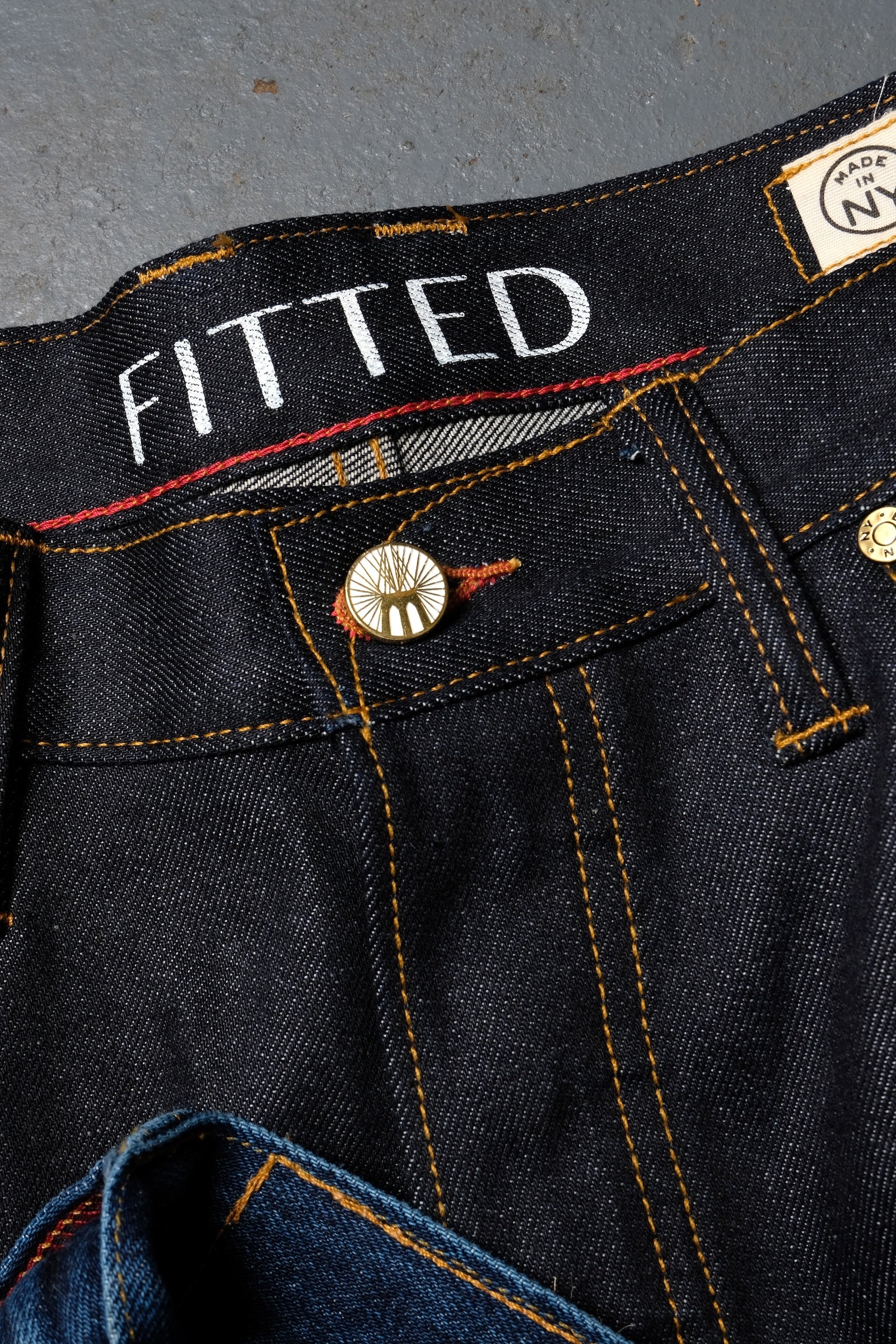
This is no longer canonical. Most mills today default to red as a base, but experiment freely — with other colors, with multiple stripes, with entirely unexpected treatments. Recently I came across a selvedge ID with a metallic finish, which I'd never seen before. I have another fabric from Burkina Faso where the selvedge ID carries the colors of the national flag. It's a beautiful expression of identity — and a reminder that the tradition is alive enough to keep evolving. But it no longer tells you definitively where the denim was milled the way it once did.
What the selvedge ID does still reliably signal is this: you're looking at selvedge construction. The stripe exists because the edge was woven rather than cut. That's real information, and it's still worth knowing.
For collectors and enthusiasts, the ID remains a point of joy — a detail that rewards attention, that distinguishes one fabric from another, that connects a pair of jeans to a specific mill and a specific tradition. It's the kind of detail that makes the denim world genuinely interesting rather than merely transactional.
What a Maker Notices
When I'm in the workshop cutting and sewing selvedge fabric, what strikes me first is texture. A well-made selvedge denim often has depth in a way that's immediately apparent to the hand. Sometimes it's a pronounced vertical slub — an irregularity in the yarn that creates a subtle ribbing in the finished fabric. Sometimes it's horizontal, or a nep that gives the surface a slight directional quality. Sometimes it's an extraordinarily even weave, almost architectural in its consistency. But there's always a sense of intention — of fabric that was made thoughtfully rather than produced at speed.
There's something I've thought about for a long time that I'll try to put into words here. A great comic leaves something behind after she walks off stage. The laughter fades, the room settles, but something from her presence lingers. The experience she created has a life of it's own; an emotional sediment that lives on after she is gone.
Great denim does something similar. You take it off at the end of the day and the experience stays with you — the weight, the way it drapes, the texture. That quality is hard to define technically, but it's unmistakable once you've felt it, and it tends to be most pronounced in the best selvedge fabrics. There is something about great selvedge denim that feels like more than the sum of its parts.
This is what I'm reaching for when I source fabric for FITTED Underground. The intangible beyond the tangible.
Why It Matters to You
Should you insist on not just raw denim, but selvedge raw denim? Probably — but you don't have to.
There is genuinely good wide goods denim out there that will develop beautiful fades and reward long wear. The selvedge edge is not a hard prerequisite for a great raw denim experience. And if budget is a constraint, a well-made pair of raw non-selvedge jeans can be a better choice than a mediocre pair of selvedge.
That said, part of the joy of raw denim is participating in a community that has spent decades thinking carefully about what makes a great pair of jeans. Within that community, the selvedge edge remains a meaningful shorthand — a signal that tends to hold water. It points toward shuttle loom construction, which points toward a certain kind of fabric quality and character that's genuinely difficult to find elsewhere.
If you're investing in a pair you intend to wear for the next five years and develop into something personal, I'd say selvedge is the right choice. The fabric has been made for this very purpose.
If you're ready to make that choice, you may want to skip to DU 201: How to Buy Your First Pair of Raw Denim Jeans, which walks through the full decision.
What Comes Next
Now that you understand what selvedge is and how it relates to raw denim, the next foundational question trips up almost every beginner: if raw denim comes in sanforized and unsanforized versions, what actually happens when you wash them — and how do you choose between them? It's a more consequential decision than most people realize.
← Previous: DU 101 — What is Raw Denim? | Next: DU 103 — Sanforized vs. Shrink to Fit →
Further Reading
- What is Selvedge Denim? The Rundown on High Quality Denim — Heddels
- Japanese Denim Selvedge Guide — Kojima Genes
- Selvedge — Denim Hunters
- The Guide to Selvedge Denim — Rivet & Hide
- What is Selvedge Denim? — Stridewise
Eric Steffen is the founder of FITTED Underground, a custom jeans and raw denim workshop at 108 Bayard Street in Williamsburg, Brooklyn. He has been making jeans by hand since 2014. Denim University is his attempt to share everything he's learned — about the history, the craft, and the culture behind the world's most enduring garment.

%0ASelvedge%20denim%20is%20one%20of%20the%20worlds%20most%20beautiful%20%E2%80%94%20and%20least%20understood%20%E2%80%94%20fabrics.%20It's%20prized%20for%20its%20fade%20potential%20and%20character.%20In%20DU%20102,%20we%20dive%20into%20the%20fundamentals%20...)
Leave a comment
This site is protected by hCaptcha and the hCaptcha Privacy Policy and Terms of Service apply.